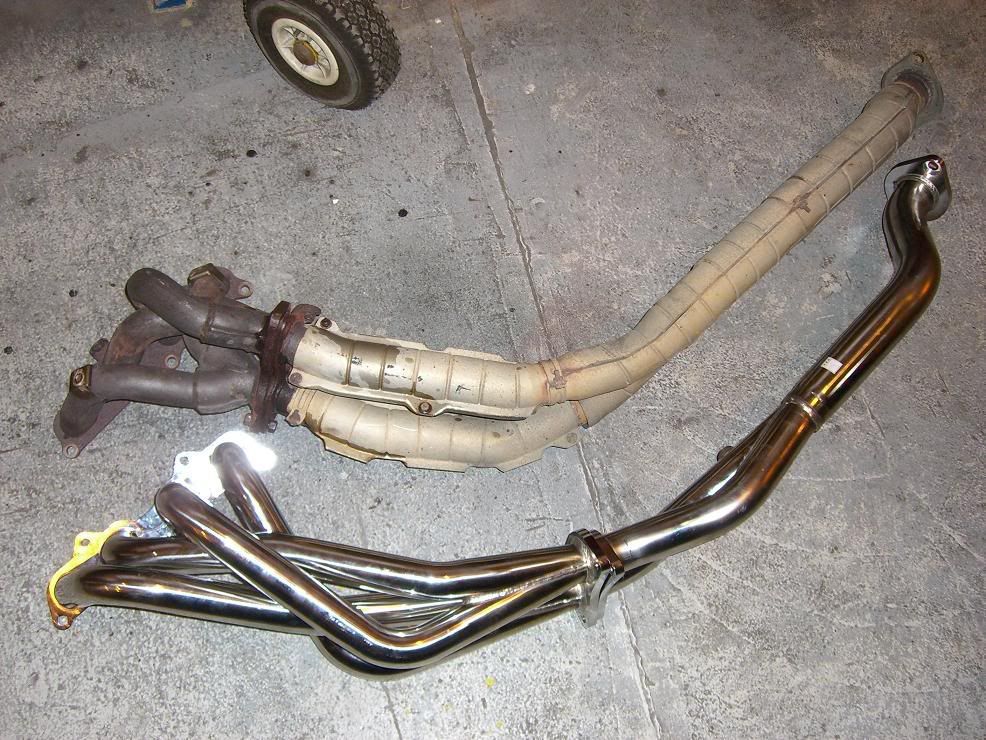
To be honest I am going to have to agree in part with Deanis here... Not from a theoretical point of view, but from observation of what works, and how headers are designed by the pros. (pertaining to my particular application, at least)
All of the 3SGE headers designed for the altezza that I've seen have been of similar design... And they're all presumably designed for high RPM power,
TODA - long primaries
TRD - long primaries
HKS - long primaries (You can see just how much longer in this pic!)
I'd like to think that at least one of those companies know what they're doing.

I cant help but wonder why the length of the primaries on the altezza is so short to begin with.
I cant help but think that it's got something to do with exhaust side VVTI, being able to adjust when the cam has a lot of overlap or not... the 270hp TRD 3SGE engine runs with VVTI disabled afterall, which might explain the radically different manifold. I cant help but think that the standard altezza manifold might not work so well on my engine which only has VVTI on the inlet side.

Perhaps although having equal length primaries is better in a theoretical world, in the real world due to the tight bends etc that you'd need to make it work well, the diminished overall flow rates possibly cancel out the gain?
Using 'second reflection' possibly ends up better off, thanks to being able to having smoother, larger radius bends in the longer distance that you've got before the pipes need to merge....
Also it seems there's two seperate issues to consider... (among others)
Tuning the length of primaries/secondaries to allow the reflected accoustic wave to stop the intake charge coming out of the exhaust, (which isnt relevant with exhaust side VVTI?)
And Tuning the primary/secondary length to use the vaccuum that follows the exhaust pulse to assist 'pulling' the next exhaust pulse out of the pipe... (which is probably what the manifold is tuned for)
I wonder how these two correlate in terms of primary/secondary length, I wouldnt be surprised to find that the required length to satisfy each requirement are radically different...
Having VVTI solve one of these problems lets the manifold length suit the other, hence the shorter than short primaries.
Although an F1 car is a great example of why primaries need to be shorter for higher RPM, it's also an example which has little relevance to a street car.... I dont think many people here are planning on pulling to 20,000rpm or so.

At the end of the day, 30hp gained in the real world is better than 40hp on paper, and long primaries seem to be what gives the results.... But I couldnt tell you why. My
TOMS extractors for the FWD setup that I had for my engine were about the same length as the standard ones, just made with mandrel bends instead of presumably bent pipe... I'm think that this is so they can still bolt them to the standard 2-1 section if people just want to buy the improved 4-2 section.
As an interesting side note, has anyone seen 'extractor' style manifolds for a turbo setup? I've always been under the impression that a shorter manifold was best, till I saw a picture that a mate sent me. It was the engine config for the R391 (or whatever the bloody thing is called) nissan lemans car, with the 3.5 V8 twin turbo. The exhaust manifolds looked to be about 7-800mm from the engine, with a 4-1 style piping setup to a collector to the turbo.
Would a similar setup have gains on a 'regular' car?