Exhaust Header theory

The place for all technical car discussions. If you haven't already, read our Disclaimer first!

Moderator: The Mod Squad

User avatar
fivebob
Toyspeed Member
Posts: 3879
Joined: Fri May 02, 2003 4:12 pm
Location: Tauranga

Post by fivebob »

deanis wrote:and wtf does cam duration have to do with resonant length. the RPM is the only thing that changes the timing of the exhaust pulses from one cylinder to another. if you have more or less cam duration the exaust valves still only open at 90 degrees after eachother.

Because the primary function of tuned length is to force any lost intake charge back into the cylinder. Extraction of exhaust gas from the next cylinder is a function of collector arrangement and flow velocity, not so much of reflected pressure waves, so length has less of an effect.
User avatar
fivebob
Toyspeed Member
Posts: 3879
Joined: Fri May 02, 2003 4:12 pm
Location: Tauranga

Post by fivebob »

deanis wrote:
Mr Revhead wrote:you state making the headers longer is for moving the HP up the RPM range
however all the evidence says not....

like your theories or dyno graphs? cause your theory is good but the dyno says otherwise.

Then why are F1 extractors so short??

At 19,000rpm they'd have to be several meters long if your theory was true :roll:
User avatar
deanis
Toyspeed Member
Posts: 75
Joined: Wed Jan 04, 2006 8:33 pm

Post by deanis »

fivebob wrote:Then why are F1 extractors so short??
packaging, haha.

na i dunno, i have seen the F1 headers down at the ferari shop in newmarket and they are very short. probably about 500mm once you take all the kinks out of them.

im starting to think i had a freak occourence on the dyno then when playing with headers. perhaps we just got lucky and randomly found something that made power. 28 horsepower to be exact, all up high and lost about 10 down low. we changed the header length by almost double and the power went nuts. your theory doesnt explain it but im not gonna complain either.

longer headers FTW (on my car only, the rest of you are all freaks)
12.7@174kph. no turbo, no supercharger, no NOS, ALLMOTOR.
User avatar
Dell'Orto
** Moderator **
Posts: 17494
Joined: Tue Jul 08, 2003 4:07 am
Location: Straight out the ghetto, Lower Hutt

Post by Dell'Orto »

If it only works on your car, wouldnt that make you the freak? ;)
1988 KE70 Wagon - Slowly rusting
1990 NA6 MX-5 - because reasons
2018 Ranger - Because workcar
1997 FD3S RX-7 Type R - all brap, all the time
OMG so shiny!

Quint wrote:Not just cock, large cock.
User avatar
IH8TEC
Toyspeed Member
Posts: 3128
Joined: Wed Nov 26, 2003 6:11 pm

Post by IH8TEC »

does having the vtec make any difference?
Current Rides: 1994 Hiace Custom
KTM 250sx

Previous Car: 1988 Toyota Levin 4agte
234kw atw and 12.5@183kmh
Sold to a muppit who wrecked it
Hmm
User avatar
bluemaumau
Toyspeed Member
Posts: 4087
Joined: Sun Oct 16, 2005 6:08 pm
Location: SYDNEY, NSW

Post by bluemaumau »

IH8TEC wrote:does having the vtec make any difference?


you cant be beaten/destroyed etc etc
4AGTE AE101 COROLLA - 90%

Where the $&#$% is that oil leak coming from /club

looking for enkei RP01 center caps (white)
User avatar
IH8TEC
Toyspeed Member
Posts: 3128
Joined: Wed Nov 26, 2003 6:11 pm

Post by IH8TEC »

lol, just wondering if that makes a difference because of how they change the lobe or whatever they do to make ubber loads of NA power
Current Rides: 1994 Hiace Custom
KTM 250sx

Previous Car: 1988 Toyota Levin 4agte
234kw atw and 12.5@183kmh
Sold to a muppit who wrecked it
Hmm
User avatar
sergei
Mad Russian
Posts: 8406
Joined: Wed May 15, 2002 11:06 am
Location: North Shore

Post by sergei »

well if you double the length you still get harmonics, and I think with double length you get second harmonic of the resonant frequency of the particular header doing the work is supposed to do (say @ 5000rpm), while the base frequency is out of range (say 2500rpm) to do any difference. This is very simplified theory.
User avatar
fivebob
Toyspeed Member
Posts: 3879
Joined: Fri May 02, 2003 4:12 pm
Location: Tauranga

Post by fivebob »

sergei wrote:well if you double the length you still get harmonics, and I think with double length you get second harmonic of the resonant frequency of the particular header doing the work is supposed to do (say @ 5000rpm), while the base frequency is out of range (say 2500rpm) to do any difference. This is very simplified theory.

No, at double length the correct frequency is half, not double. The second harmonic works for half the length ;)
Titties
Toyspeed Member
Posts: 140
Joined: Fri Mar 05, 2004 10:26 pm
Location: West Auckland

Post by Titties »

'98 RS200 Altezza - SOLD
'96 Mitsi Mirage, 11.12 @ 124mph (200kph)
User avatar
barryogen
2ZZ Guru in training
Posts: 2692
Joined: Thu Oct 13, 2005 7:38 am
Location: Dunedin
Contact:

Post by barryogen »

Thats quite an interesting article... not overly informative though, and didn't really cover much of the info on primary vs secondary length.

I mean I understand that it is all about pulses, and getting them to scavenge as much as possible to increase the flow, but how primary and secondary length changes that is still a mystery.

hell, my car doesn't even have secondaries, it's a tuned length header that seems almost impossible to improve upon(barring getting the TRD equivalent), it is simply the primaries straight into the collector type area where it goes to the CAT etc etc...
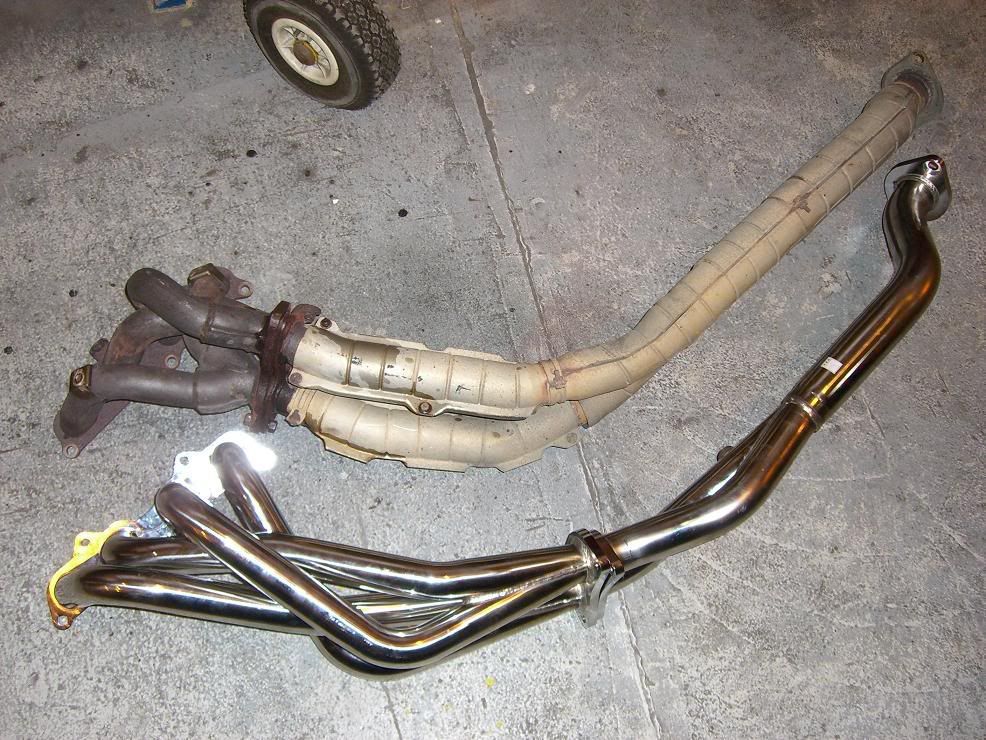
This isn't the OEM one, but it is close enough to it in lok for you to get what I mean.
Image
User avatar
barryogen
2ZZ Guru in training
Posts: 2692
Joined: Thu Oct 13, 2005 7:38 am
Location: Dunedin
Contact:

Post by barryogen »

actually I just found a 95 page PDF on thermo dynamics and the "Theory of the inlet and exhaust processes of internal combustion engines" written by some dude from the National Advisory Committee for Aeronautics.

I'll see if I can chuck it online somewhere... it's quite a good read so far.
User avatar
KinLoud
** Moderator **
Posts: 2893
Joined: Thu May 16, 2002 6:39 pm
Location: Auckland
Contact:

Post by KinLoud »

Hey I would really like to see the dyno printout that shows the dyno run where the "power went nuts". Also include all the other dyno runs and dimensions and pics of the exhaust manifolds you used.

Ken
Ham
021 408 863
I used to think that the orange and green tictacs gave you special powers. The orange ones would make you stronger and the green ones would make you faster. So i used to eat some green ones and run around my lounge as fast as i could, then eat the orange ones and try to pick up the sofa. I wish it were true!
User avatar
RomanV
Toyspeed Member
Posts: 4915
Joined: Tue Aug 12, 2003 11:17 pm
Location: West Auckland

Post by RomanV »

To be honest I am going to have to agree in part with Deanis here... Not from a theoretical point of view, but from observation of what works, and how headers are designed by the pros. (pertaining to my particular application, at least)

All of the 3SGE headers designed for the altezza that I've seen have been of similar design... And they're all presumably designed for high RPM power,

TODA - long primaries

TRD - long primaries

HKS - long primaries (You can see just how much longer in this pic!)

I'd like to think that at least one of those companies know what they're doing. :)

I cant help but wonder why the length of the primaries on the altezza is so short to begin with.

I cant help but think that it's got something to do with exhaust side VVTI, being able to adjust when the cam has a lot of overlap or not... the 270hp TRD 3SGE engine runs with VVTI disabled afterall, which might explain the radically different manifold. I cant help but think that the standard altezza manifold might not work so well on my engine which only has VVTI on the inlet side. :cry:

Perhaps although having equal length primaries is better in a theoretical world, in the real world due to the tight bends etc that you'd need to make it work well, the diminished overall flow rates possibly cancel out the gain?
Using 'second reflection' possibly ends up better off, thanks to being able to having smoother, larger radius bends in the longer distance that you've got before the pipes need to merge....

Also it seems there's two seperate issues to consider... (among others)

Tuning the length of primaries/secondaries to allow the reflected accoustic wave to stop the intake charge coming out of the exhaust, (which isnt relevant with exhaust side VVTI?)

And Tuning the primary/secondary length to use the vaccuum that follows the exhaust pulse to assist 'pulling' the next exhaust pulse out of the pipe... (which is probably what the manifold is tuned for)

I wonder how these two correlate in terms of primary/secondary length, I wouldnt be surprised to find that the required length to satisfy each requirement are radically different...
Having VVTI solve one of these problems lets the manifold length suit the other, hence the shorter than short primaries.

Although an F1 car is a great example of why primaries need to be shorter for higher RPM, it's also an example which has little relevance to a street car.... I dont think many people here are planning on pulling to 20,000rpm or so. :o

At the end of the day, 30hp gained in the real world is better than 40hp on paper, and long primaries seem to be what gives the results.... But I couldnt tell you why. My TOMS extractors for the FWD setup that I had for my engine were about the same length as the standard ones, just made with mandrel bends instead of presumably bent pipe... I'm think that this is so they can still bolt them to the standard 2-1 section if people just want to buy the improved 4-2 section.


As an interesting side note, has anyone seen 'extractor' style manifolds for a turbo setup? I've always been under the impression that a shorter manifold was best, till I saw a picture that a mate sent me. It was the engine config for the R391 (or whatever the bloody thing is called) nissan lemans car, with the 3.5 V8 twin turbo. The exhaust manifolds looked to be about 7-800mm from the engine, with a 4-1 style piping setup to a collector to the turbo.
Would a similar setup have gains on a 'regular' car?

Flannelman
formerly known as Affroman
Posts: 461
Joined: Mon Jul 19, 2004 8:43 pm
Location: Old Plymouth

Post by Flannelman »

to add quickly, i put on FGK extractors on a silvertop 20v.
power was 78kW@7800-8000 rpm before the change.
After power improved to 84kW@7800. a very visible torqure increase starts at 5000 and holds to 6500 before falling. (can feel it in the car too)

Visibly the only difference is in size of pipe. the lenght is the same as standard. These extractors are 4-2-1 design.

to see a dyno proven Shorter is better, i will try and unbolt them so they are a very short primary, all with single runners. better put on some ear muffs for that experiment.
FWIT - the dirty aircleaner was replaced with a clean one and grabbed extra 2kW. little advance and got 1.5kW more. Droping the muffler made no change to power, just the noise of the thing!
User avatar
rollaholic
Toyspeed Member
Posts: 5383
Joined: Fri May 28, 2004 1:19 am
Location: West is Best

Post by rollaholic »

the F1 example has plenty of relevance to a street car, they both use reciprocating internal combustion engines after all.

its an extreme example used to illustrate the theory, the fact that street cars dont rev to 19000rpm doesnt invalidate the example.

very interesting topic!
BASU!
User avatar
fivebob
Toyspeed Member
Posts: 3879
Joined: Fri May 02, 2003 4:12 pm
Location: Tauranga

Post by fivebob »

rollaholic wrote:the F1 example has plenty of relevance to a street car, they both use reciprocating internal combustion engines after all.

its an extreme example used to illustrate the theory, the fact that street cars dont rev to 19000rpm doesnt invalidate the example.

Precisely, the F1 is entirely relevant to the subject at hand, namely is shorter or longer the correct way to go for high rpm. In fact I would go so far as to say it's more relevant than any street engine, which is always going to be a compromise between power and drivability ;)

What some people don't seem to understand is that the tuned length is not just the length of the primaries, it's the length of the secondaries as well. A 4-1 will always produce more power than a 4-2-1, but at the expense of low end torque. So perhaps these aftemarket systems use longer primaries in an effort to make it closer to a 4-1 to get max power out of their system, without sacrificing too much down low.

Another thing to consider is that as Exhaust duration increases the pipe length should increase, so perhaps these systems are tuned for the high RPM VVTi setting. I also note that the tuned length of these systems don't seem to be much different from the stock tuned length ;)
ALLTREC_TURB
Toyspeed Member
Posts: 179
Joined: Tue Jan 02, 2007 1:26 pm
Location: Rahotu, Taranaki

Post by ALLTREC_TURB »

Just out of curiosity, does this theory and/or formulas translate to turbo exhaust manifolds is well, or is all this applicable to N/A specifically
User avatar
rollaholic
Toyspeed Member
Posts: 5383
Joined: Fri May 28, 2004 1:19 am
Location: West is Best

Post by rollaholic »

i doubt its as important, it seems unlikely that the returning pulse would have enough pressure to push intake charge back into the cylinder during valve overlap due to the increased pressure on inlet side in turbo charged engines - also the reason larger diameter exhausts are beneficial on turbo vehicles, since exhaust scavenging is not as important due to compressed intake charges pushing out remaining exhaust gases (rather than being sucked in by the low pressure created by descending piston)
BASU!
frost
Toyspeed Member
Posts: 1705
Joined: Mon Aug 08, 2005 10:19 pm

Post by frost »

A 4-1 will always produce more power than a 4-2-1, but at the expense of low end torque


thats old school thinking, its been proven many times on wheelsjamaica.com with dyno plots showing 4>1's dont loose low end, infact in a few different brands low end was better then 4>2>1 plots. im searching for the pages...
this was done on 20v blacktop application,
Post Reply