Jabsco raw water pump, generally used in marine colling systems,
Try the likes of lusty and blundall, burnsco etc
Heaps of variety,
Jabsco is a brand, and usually at the expensive end, there are other cheaper brands also but no brand names tha i can think of
Water pump
Moderator: The Mod Squad
-
Mr Revhead

- SECURITY!
- Posts: 24635
- Joined: Tue Jan 20, 2004 3:06 pm
- Location: Nelson
- Contact:


Grrrrrrr! wrote:sergei wrote:
3) Brand new ST205 pump is a tad over $100, and flows well enough to satisfy your needs (or any other needs).
So what flow rate exactly does a st205 pump provide at 5psi,8psi and 10psi, i'd love to know, because so far i haven't been able to find any actual data on what that pump flows. Then if you could just tell me exactly what my needs are it'll save me a bit of time and a bunch of heat transfer calcs.. kthxbye.
You haven't told us anything about how much heat you want to dissipate.
One would assume you definitely do not make 1000kW, and most likely your engine output is below 500kW. Hence my assumption that ST205 water pump will be sufficient. I do not have figures for ST205 water pump. I do have figures for Legacy AWIC system.
Basically the legacy Intercooler has capacity of about 4kW heat dissipation, while the radiator is at about 5kW, the pump which runs this system is rated at 15L/min, and is not running full time.
The ST205 intercooler has bigger core, the radiator is more than twice larger, and pump is definitely larger. Actually compared to Subaru (or ST165, as they are almost identical) the pump is much larger, the impeller is massive. The outlets are larger as well.
I would put the ST205 intercooler at about 10+kW of dissipation capacity. Pump is definitely not a problem in this system.
As for pressure, you would be struggling to find any centrifugal water pumps that will work well above 0.3bars of restriction.
Here is some real life data:
My setup was ST205 intercooler, Legacy I/C radiator and 15L/h pump (legacy/ST165). The intake temperatures were stable at 195kW at the wheels, which means the legacy 5kW is sufficient up to 200kW at the wheels (of course that depending how efficient is your turbo). This also suggests that 15L/h pump was also sufficient for the task.
Of course I will be upgrading legacy I/C radiator and pump to ST205 units, because the car will be seeing some track duties and the conditions (the air flow through radiator) will not be the same as on the dyno.
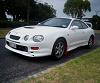
here is some real real life data of me giving it a squirt the other day
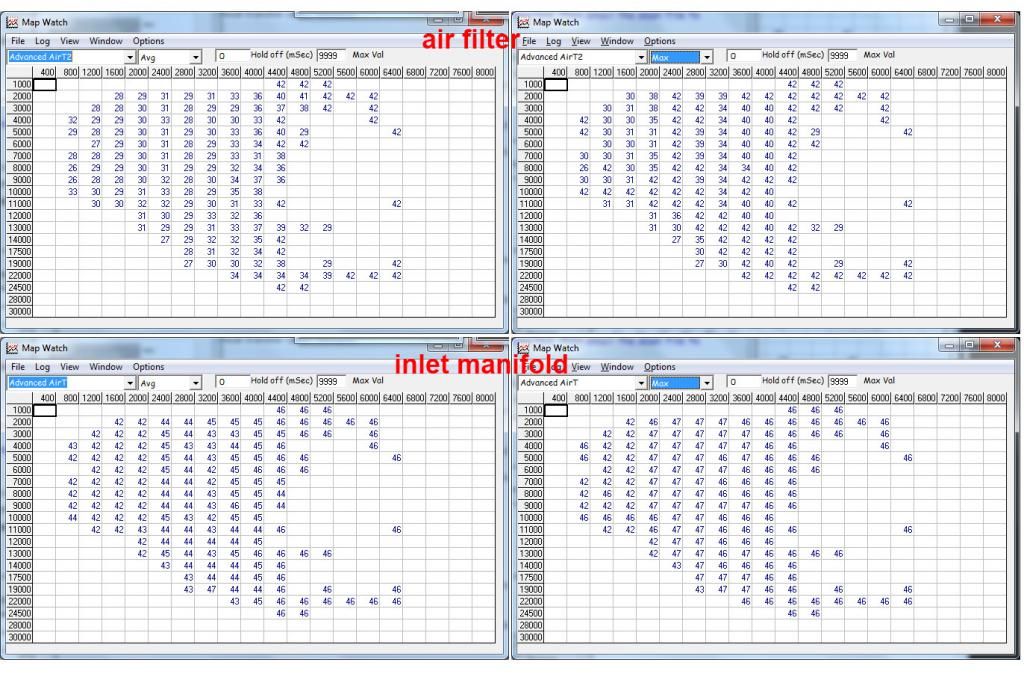
ambient + 12 deg consistent, 22000 on the load axis is 1.1bar of boost, 24500 is 1.3bar, so power is roughly 180-190kw on 4 wheels
ambient + 12 deg consistent, 22000 on the load axis is 1.1bar of boost, 24500 is 1.3bar, so power is roughly 180-190kw on 4 wheels
Last edited by gt4dude on Mon Jan 07, 2013 9:31 am, edited 2 times in total.
セリカGT-FOUR ST205 中期型 (Chuuki)
GT2860RS ・ JE 86.5φ PISTON ・ FX400 CLUTCH ・ APEX P-FC
200AWKW / 370NM
GT2860RS ・ JE 86.5φ PISTON ・ FX400 CLUTCH ・ APEX P-FC
200AWKW / 370NM
On a hot day, there is roughly 30kW of heat to lose to get intake temps to where i want them (about 30* above ambient) judging from ballpark figures I punched into the borg warner turbo selector website.
Piping may have to get larger to keep the restriction down to 5psi max, but high flow is the only option to keep the size of the intercooler core and heat exchanger reasonable.
Piping may have to get larger to keep the restriction down to 5psi max, but high flow is the only option to keep the size of the intercooler core and heat exchanger reasonable.
Reality: A nasty hallucination that is caused by excess blood in the alcohol stream.
Grrrrrrr! wrote:On a hot day, there is roughly 30kW of heat to lose to get intake temps to where i want them (about 30* above ambient) judging from ballpark figures I punched into the borg warner turbo selector website.
Piping may have to get larger to keep the restriction down to 5psi max, but high flow is the only option to keep the size of the intercooler core and heat exchanger reasonable.
I am interested in those calculations.... 30kW is a lot of heat.
turbo outlet temp 325F = 162*C (from matchbot)
Mass flow = 0.302kg/s (from matchbot)
desired throttle body temp 60*C
DeltaT = 102*C
specific heat capacity of air ~1 kJ/K.kg
0.302 * 102 * 1 = 30.8kW.
and thats only at 400 hp power levels.
Mass flow = 0.302kg/s (from matchbot)
desired throttle body temp 60*C
DeltaT = 102*C
specific heat capacity of air ~1 kJ/K.kg
0.302 * 102 * 1 = 30.8kW.
and thats only at 400 hp power levels.
Reality: A nasty hallucination that is caused by excess blood in the alcohol stream.
Grrrrrrr! wrote:turbo outlet temp 325F = 162*C (from matchbot)
Mass flow = 0.302kg/s (from matchbot)
desired throttle body temp 60*C
DeltaT = 102*C
specific heat capacity of air ~1 kJ/K.kg
0.302 * 102 * 1 = 30.8kW.
and thats only at 400 hp power levels.
Working backwards (from 0.302kg/s) I assume you are going to run something like 1.5-1.7Bar on a 2.0L? That would explain 160+ 'C and >30kW dissipation needed.
Yes, there are multiple issues, hence why i'm doing some research and looking at options. unfortunately a big FMIC isn't an option, or there would be no drama and i wouldn't be faffing around looking at w2a. Got anything constructive to contribute?
Reality: A nasty hallucination that is caused by excess blood in the alcohol stream.
-
nz_climber
- Toyspeed Member
- Posts: 322
- Joined: Sat Dec 20, 2003 9:29 pm
- Location: Bulls
- Contact:
nz_climber wrote:Faster water flow through the radiator core will not always be better, there needs to be time for the heat transfer to occur.
Maybe something to consider.. (not sure on the exact figures so happy to be proven wrong)
Thats just another internet myth.
Reality: A nasty hallucination that is caused by excess blood in the alcohol stream.
FWIW we run a single small electric water pump on the W2A intercooler on the MRS,
and another electric one for main radiator cooling too.
Not very good pic's but here are some from the build thread showing the pumps we used.
http://i277.photobucket.com/albums/kk58 ... pic137.jpg
shows the IC pump,
http://i277.photobucket.com/albums/kk58 ... pic860.jpg
shows the pump for the radiator, as the engine had no water pump itself anymore.
and another electric one for main radiator cooling too.
Not very good pic's but here are some from the build thread showing the pumps we used.
http://i277.photobucket.com/albums/kk58 ... pic137.jpg
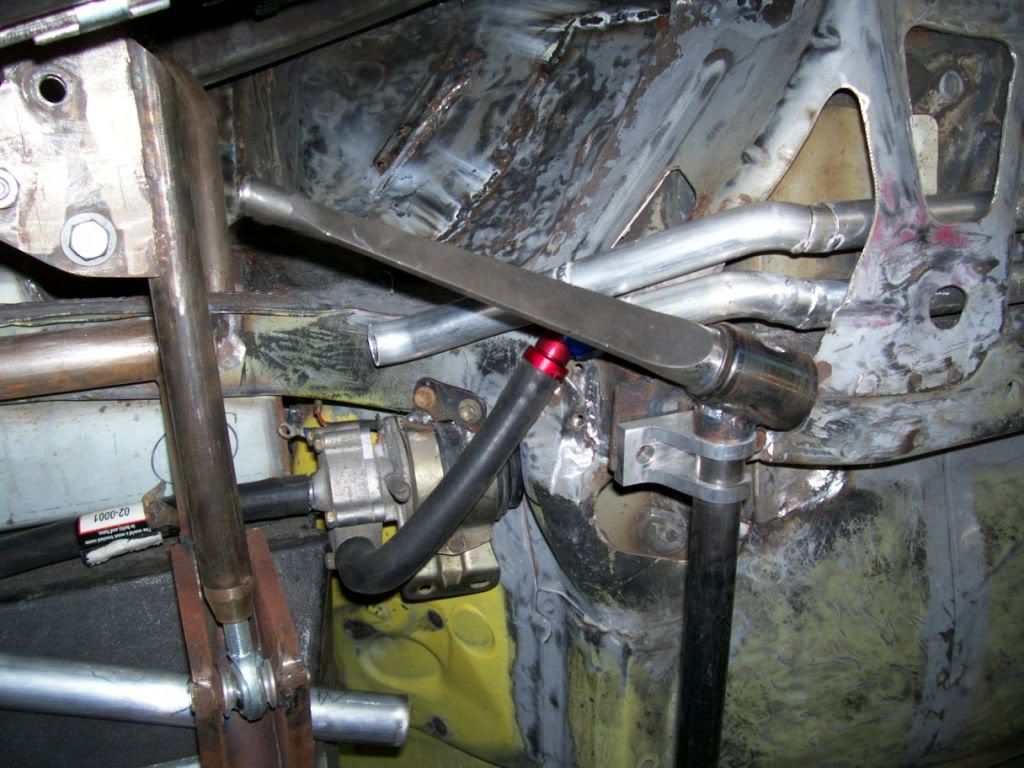
shows the IC pump,
http://i277.photobucket.com/albums/kk58 ... pic860.jpg
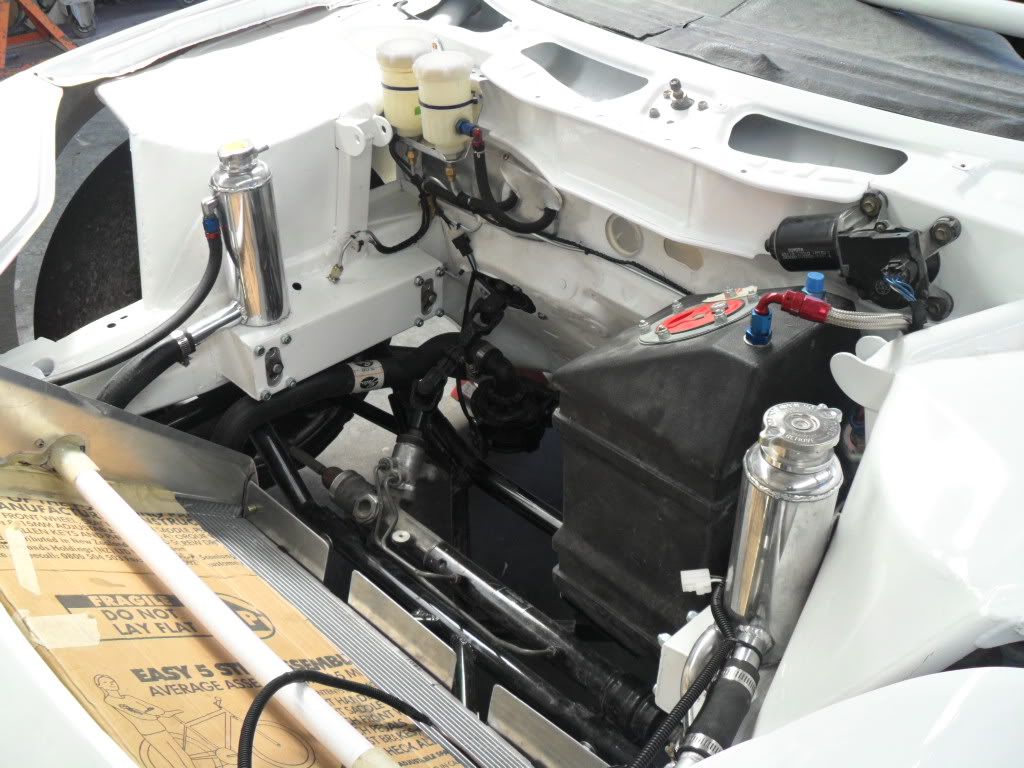
shows the pump for the radiator, as the engine had no water pump itself anymore.
Grrrrrrr! wrote:nz_climber wrote:Faster water flow through the radiator core will not always be better, there needs to be time for the heat transfer to occur.
Maybe something to consider.. (not sure on the exact figures so happy to be proven wrong)
Thats just another internet myth.
Not quite a myth. In every heat transfer there is a time factor. How fast the heat is transferred is dictated by temperature difference. It will cool faster if it is hotter, it will heat faster if it is colder.
http://www.physicsclassroom.com/class/thermalP/u18l1f.cfm
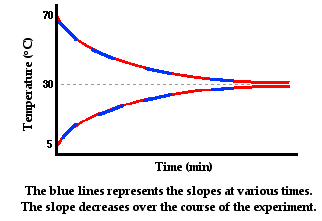
So theoretically having too much flow will increase average temperature.
Correct, the rate of heat tranfers is dictated by the temperature difference which is why more mass flow wins every time. More mass flow means you are pushing the water that has already cooled away from the face of the heat exchanger and replacing it with warmer water, therefore it is more efficient.
That graph is irrelevant, thats for heat transfer between two masses in a closed system. Not relevant to an open system with net energy changes.
Go to this website and play with the calculator. Setup some numbers, then double one of the flow rates... result is more heat transfer, everytime.
That graph is irrelevant, thats for heat transfer between two masses in a closed system. Not relevant to an open system with net energy changes.
Go to this website and play with the calculator. Setup some numbers, then double one of the flow rates... result is more heat transfer, everytime.
Reality: A nasty hallucination that is caused by excess blood in the alcohol stream.
Grrrrrrr! wrote:Correct, the rate of heat tranfers is dictated by the temperature difference which is why more mass flow wins every time. More mass flow means you are pushing the water that has already cooled away from the face of the heat exchanger and replacing it with warmer water, therefore it is more efficient.
That graph is irrelevant, thats for heat transfer between two masses in a closed system. Not relevant to an open system with net energy changes.
Go to this website and play with the calculator. Setup some numbers, then double one of the flow rates... result is more heat transfer, everytime.
That calculator is irrelevant as all it probably does is fudges the data into the preset calculations. Without seeing the source of the calculator (and formulae they used to calculate). I have no trust in the programmers
 .
.matt dunn wrote:
http://i277.photobucket.com/albums/kk58 ... pic860.jpg
shows the pump for the radiator, as the engine had no water pump itself anymore.
2nd pic / engine pump looks like a davies craig. Have you had any issues with it ?
Reason i ask is i'm using one for the W2A and it regularly burns the seal out, letting water into the motor / out of the system and then next time i use it the bearing have seized in the motor.
What problems did the Formula SAE car have GRRRR